
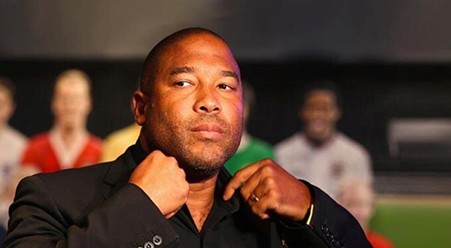
John Barnes MBE is a legendary figure in English football and one of the nation’s most sought-after after dinner speakers, celebrated for his captivating stories from an illustrious career.
A dynamic winger who lit up Anfield for over a decade, Barnes won multiple league titles and FA Cups with Liverpool, while earning over 70 caps for England.
Since hanging up his boots, he has become a respected pundit, manager, and influential voice on tackling discrimination in sport.
In this exclusive interview with The Champions Speakers Agency, Barnes offers frank insights on racism in football, the progress made, and the challenges that remain.
Q: Can you elaborate on the distinction between racism and racist incidents?
John Barnes: “Generally, I’m from quite an elite background. My father was a diplomat, and my mother’s family were quite political in Jamaica, so I considered myself to be privileged.
“Since I was 17 years old, I played football professionally for England. I lived in a nice house, so therefore I was privileged, and when I started to play football, I became even more privileged.
“What happened to me was that I experienced racist incidents — bananas came on the field, I would have gotten racist abuse. That’s for 90 minutes on a Saturday or Wednesday, but for the other six days of the week, I could go to the front of any queue, I could go to the Houses of Parliament and speak to the Prime Minister.
“I would be allowed into the higher echelons of society because of my privilege of being a footballer or a celebrity.
Racial incidents as black elite
“Any negative aspect I experienced as a black person were incidents.
“What I refused to do, as Martin Luther King said in about 1962, was capitalise on negative aspects of blackness while not enduring the everyday black experience.
“The everyday black experience is for the average black person who can’t get a job, can’t get a house, is imprisoned, is picked upon every single day of their lives. That doesn’t happen to me or a lot of the black elite.
“That is why I’m using my voice to talk about how things are bad. Yes, we need more black people winning Oscars, and we need John Barnes, from a footballing perspective, to get a job as a manager.
“But things are much worse for the average black person in the inner cities, and that’s who we should be speaking about.”
YOU MAY ALSO LIKE: Football news: Defence a concern for Arne Slot as Liverpool lose Community Shield final
Q: Could you discuss past racism in the Premier League and the progress since?
John Barnes: “While I then got on a nice coach to go home, drinking an Asti Spumante wine and having my fillet steak, I would look out of the window and see black fans cowering in corners, hiding around corners and being attacked. No one spoke for them because they felt sorry for me.
“That is why I say, even from that point of view, yes, it would have been bad. However, unconscious bias is such an important thing that we really have to address.
“I wouldn’t accuse fans of being overly, necessarily racist — of course they go along with the crowd and their unconscious bias.
“Back when I played, there weren’t as many black footballers as there are now. How many white American footballers are there?
“I’m sure they have lots of good players, but the perception we have of Americans is that they don’t play football, just like the perception we have of black people is that they can’t think too much, so we don’t put them into positions of power.
“How do we feel about women? We don’t put them in these Fortune 500 companies and director roles because women aren’t supposed to do that. It’s all to do with the unconscious bias that we have.”
Q: What are your thoughts on the lack of black coaches and opportunities in sports?
John Barnes: “The Rooney Rule came in because there were three or four black coaches 25 years ago.
“Here we are, 20-odd years later, and there are still only three, if that. Had the Rooney Rule worked? You can’t pass laws; you have to change people’s perceptions. There are always ways around the laws.
“What you have to do is change your perception of that person’s intellectual worth, morality, and leadership qualities — then you’ll see more black coaches.
“You can’t just force people to give a black man a job, because after a while, there will always be ways around you not giving him a job without it being illegal.
Combating racism
“I understand affirmative action and positive discrimination, but we have to move on and start changing perceptions rather than just putting laws in place. It’s been illegal to murder and kill for a thousand years.
“After the American Civil War, you had a lot of black leaders in America until the Jim Crow laws came in, because all you did was put laws in place without changing the perception of the worth of that person.
“Too many people are talking about passing laws without changing perceptions.”
This exclusive interview with John Barnes was conducted by Chris Tompkins of The Motivational Speakers Agency.
READ NEXT: Mohamed Salah challenges UEFA over tribute to ‘Palestinian Pele’
 SportJustSport writers